In the passenger transport industry, compliance is not optional.
It is existential.
Operators live in a regulatory environment shaped by:
- Operator licensing conditions
- Driver hours regulations
- Vehicle maintenance standards
- Insurance requirements
- Health & safety legislation
And yet — in 2026 — many fleets still manage compliance using:
- Spreadsheets
- Shared drives
- Paper folders
- Calendar reminders
- Individual memory
That model might feel familiar.
It may even feel controlled.
But in a growing, regulated, multi-stakeholder environment, spreadsheet governance is no longer merely inefficient — it is structurally fragile.
The real question is no longer:
“Is the spreadsheet working?”
It is:
“What happens when it doesn’t?”
The regulatory pressure on fleet operators has never been higher
Passenger transport operators operate under strict oversight from bodies such as the Driver and Vehicle Standards Agency and Traffic Commissioners in the UK.
Source: https://www.gov.uk/government/organisations/driver-and-vehicle-standards-agency
Requirements typically include:
- Preventative maintenance inspections (PMIs)
- Accurate record keeping
- Driver qualification tracking
- Tachograph compliance
- Defect reporting processes
Failure to demonstrate effective systems can lead to:
- Public inquiries
- Financial penalties
- Licence curtailment
- Reputational damage
Compliance is not simply about doing the right thing.
It is about proving — at any moment — that you are doing it consistently.
Why spreadsheets became the default
Spreadsheets are attractive because they are:
- Cheap
- Flexible
- Familiar
- Customisable
They allow operators to build systems quickly without specialist software.
But spreadsheets were designed for:
- Calculation
- Analysis
- Reporting
They were not designed for:
- Real-time governance
- Multi-user compliance control
- Audit resilience
- Automated risk prevention
And that distinction matters.
The hidden fragility of spreadsheet governance
Spreadsheets fail quietly.
They don’t raise alarms when:
- A PMI date is mis-entered
- A driver’s CPC expiry is overlooked
- A defect report is not logged
- A maintenance interval slips
Instead, errors remain dormant until:
- An audit
- An inspection
- A roadside stop
- An accident investigation
At that moment, governance moves from operational detail to existential risk.
Governance risk isn’t operational — it’s strategic
Many operators view compliance as an operational department function.
But governance failure impacts:
- Board-level accountability
- Insurance exposure
- Contract eligibility
- Investor confidence
- Brand reputation
The Chartered Institute of Internal Auditors emphasises that governance failures in regulated sectors typically stem from weak control systems, not deliberate misconduct.
Source: https://www.iia.org.uk
In other words:
Collapse is rarely caused by intent — it is caused by invisible system weakness.
The myth of “we’ve always managed it this way”
One of the most dangerous beliefs in transport governance is:
“It’s always worked.”
Past survival is not proof of structural strength.
Growth changes risk exposure:
- More vehicles
- More drivers
- More routes
- More maintenance events
- More regulatory scrutiny
Complexity increases non-linearly.
Spreadsheets do not scale safely under complexity.
Where spreadsheet governance breaks down
1. Lack of real-time visibility
Spreadsheets provide snapshots — not live control.
In fast-moving operations:
- Data is outdated quickly
- Updates depend on discipline
- Errors propagate silently
Without real-time dashboards, compliance becomes reactive.
2. No automated control mechanisms
True governance requires:
- Alerts
- Escalation triggers
- Access control
- Audit trails
Spreadsheets rely on:
- Human memory
- Manual review
- Informal oversight
That is not governance.
It is an administration.
3. Version control risk
Multiple users create:
- Duplicate files
- Conflicting updates
- Overwritten data
In an audit situation, this undermines confidence immediately.
4. No defensible audit trail
In regulated industries, documentation must demonstrate:
- Who did what
- When it was done
- What changed
- Why it changed
Spreadsheets are notoriously weak in producing structured audit logs.
The cost of compliance failure
Governance breakdown can result in:
- Public inquiries
- Licence restrictions
- Reputational headlines
- Increased insurance premiums
The Department for Transport outlines the importance of demonstrable systems and management control in operator licensing frameworks.
Failure is not judged only on the incident, but on system robustness.
Moving governance beyond the spreadsheet
Modern fleet governance systems integrate:
- Vehicle maintenance scheduling
- Driver licence and CPC tracking
- Defect reporting workflows
- Compliance alerts
- Centralised document control
This transforms compliance from a static record-keeping exercise into an active risk management system.
What strategic governance looks like
1. Automated compliance alerts
Systems flag:
- Upcoming inspections
- Expiring documentation
- Overdue maintenance
- Risk anomalies
Instead of discovering problems late, operators prevent them early.
2. Centralised data control
All compliance data lives in:
- A single controlled system
- With defined access rights
- With clear version control
This eliminates spreadsheet sprawl.
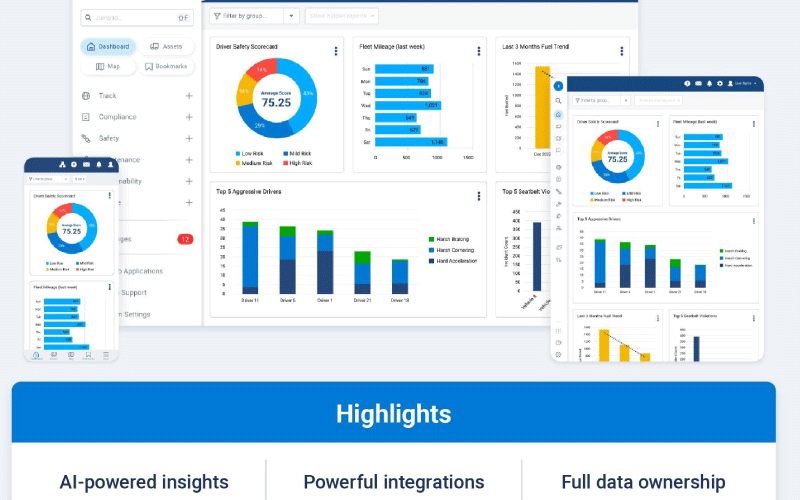
3. Real-time dashboard visibility
Directors and managers can instantly see:
- Fleet compliance status
- Upcoming risks
- Outstanding issues
- Trends over time
Governance becomes visible — not assumed.
4. Defensible audit trails
Modern systems record:
- User actions
- Time stamps
- Data edits
- Escalations
In an inspection or inquiry, this transforms your position from defensive to confident.
Compliance maturity as a competitive advantage
Large contracts increasingly demand:
- Documented compliance systems
- Evidence of governance processes
- Data transparency
Organisations that modernise governance:
- Win more tenders
- Retain contracts longer
- Negotiate insurance more effectively
- Attract higher-quality partnerships
Compliance is no longer back-office admin — it is commercial leverage.
The psychological shift: from reactive to controlled
Spreadsheet-based compliance creates:
- Low-level anxiety
- Dependency on key individuals
- Fear of audits
Digitised governance creates:
- Predictability
- Confidence
- Accountability
This cultural shift is as important as the technology itself.
When is it time to move beyond spreadsheets?
Warning signs include:
- Reliance on one “compliance expert”
- Multiple versions of the same file
- Manual diary reminders
- Difficulty producing documentation quickly
- Increasing fleet size
- Rising insurance scrutiny
If governance feels fragile, it probably is.
The strategic imperative
In regulated transport operations, compliance failure is rarely gradual.
It is sudden.
An inspection, a roadside stop, a serious incident — and suddenly the quality of your systems is under scrutiny.
The operators who thrive in the next phase of the industry will not simply meet compliance.
They will demonstrate governance maturity.
Spreadsheets are tools.
Governance requires systems.
Final thought: compliance or collapse
The choice is not between:
- Spreadsheet vs software
It is between:
- Reactive administration
- Strategic control
FAQ
Why are spreadsheets risky for fleet compliance?
Spreadsheets lack automated alerts, version control, and audit trails, making them fragile under regulatory scrutiny.
What is fleet governance software?
Fleet governance software centralises maintenance, driver compliance, defect reporting, and documentation into a controlled, auditable system.
Can compliance software prevent licence risk?
While no system eliminates risk, automated alerts and structured controls significantly reduce the likelihood of missed obligations.
When should operators move beyond spreadsheets?
When fleet size grows, compliance complexity increases, or documentation retrieval becomes difficult under inspection.